Showing posts with label Propagation. Show all posts

Wednesday, March 18, 2015

Sun Fart

Our geomagnetic field is currently doing a song and dance with old Sol.


Via The Watchers:
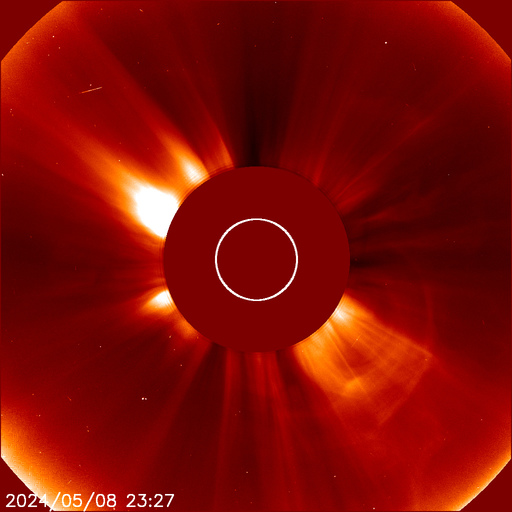
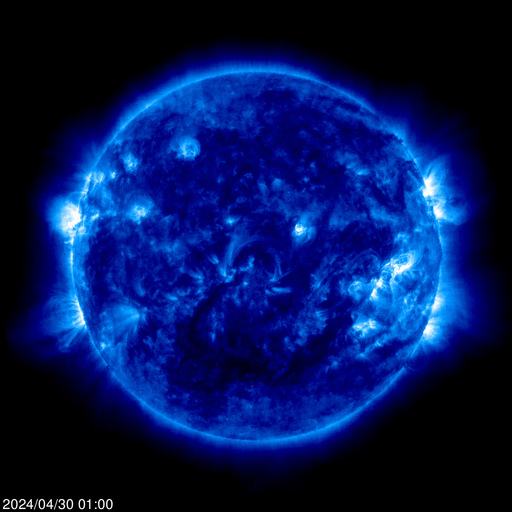
A sequence of events led to an Earth-directed asymmetric halo CME on March 15, 2015. The events began with a 14 degree long filament eruption, centered near S24W38, lifting off between 00:45 to 02:00 UTC. This was followed by C2.4 flare at 00:41 UTC and a long duration C9.1 at 02:13 UTC, both from Region 2297. 
Associated with the C9.1 flare were low-frequency radio emissions including Type II (estimated velocity 745 km/s) and Type IV radio sweeps. WSA/ENLIL modelling showed an approximate arrival time around 20:00 on March 17. However, it appears this CME arrived some 16 hours earlier (see update #2).
An interplanetary shock wave arrived at the ACE spacecraft around 04:15 UTC and at Earth a half hour later.Geomagnetic K-index of 5 (G1 - Minor) threshold was reached at 05:59 UTC. Potential impacts: Area of impact primarily poleward of 60 degrees Geomagnetic Latitude. Weak power grid fluctuations can occur. Minor impact on satellite operations are possible. Aurora may be visible at high latitudes, i.e., northern tier of the U.S. such as northern Michigan and Maine.
A G2 - Moderate geomagnetic storm warning has been issued based on solar wind signatures at the ACE spacecraft. Under G2 conditions, area of impact is primarily poleward of 55 degrees Geomagnetic Latitude. Power grid fluctuations can occur. High-latitude power systems may experience voltage alarms. Satellite orientation irregularities may occur; increased drag on low Earth-orbit satellites is possible. HF (high frequency) radio propagation can fade at higher latitudes. Aurora may be seen as low as New York to Wisconsin to Washington state.
Update #1: 
Geomagnetic K-index of 6 (G2 Moderate geomagnetic storm) threshold was reached at 08:46 UTC.
Update #2:
Initial SWPC's diagnosis suggested the arrival of the anticipated CME from March 15, however, the subsequent temperature and density measurements pointed towards a recurrent negative polarity coronal hole high speed solar wind stream (CH HSS). 
The disturbed conditions may be the combined effects of the high speed stream and CME.
Geomagnetic K-index of 7 or greater (G3 or greater - Strong to Extreme) is expected as the impacts from today's shock continue. 
Update #3:
Geomagnetic K-index of 8 (G4 Severe) threshold was reached at 13:58 UTC. 
I wasn't on the radio at all this afternoon (17-Mar) so I can't say how the conditions on the higher bands were. Tonight (18-Mar @ 0300 UTC) 40m has a noise level at S3, with occasional crashes as high as S5. The A index was 100 earlier, currently 117 with a K of 6.

9Q0HQ (Dem. Rep. of Congo) is about S4 on 40m, maybe a little weaker than they've been this past week but still readable; 7QAA (Malawi) is a bit stronger at S5 on 40m and about S4 on 30m. Oddly, hardly any other stations heard on 30m at this time other than a few stateside ops, but there are a few EU signals on 40m.


Tuesday, January 7, 2014

The Last Continent


Antarctica has eluded me for years. I'd see cluster spots for various Antarctic operations but never heard anything other than the pileups of stations calling and working them. Blame it on poor propagation or crappy antennas or both, it just never happened for me. Until last night.

I noticed a lot of spots by stateside ops for DP1POL at Neumayer Station on the DXWatch.com web cluster while surfing the web (do people still say that?) in the living room around 0300. He was QRV on 40m CW where I've had a lot of success these past few months working and hearing southern South America in the evenings, so I thought it might be a good idea to check it out.

As soon as I clicked the spot on the shack PC, I heard him 57 to 59. Found where he was listening, tuned the K3's XIT up about 1.4 kHz, got him on my second call, and proceeded to do the happy dance (thank you, Felix!). Eight hours later I woke up to find his QSL in my LOTW account -- DXCC #122 in the books!

ClubLog's Geographic Propagation Wizard suggests I stumbled upon DP1POL at the best possible time:


Neumayer Station II is not quite due south from my QTH, about 155° beam heading (which means little to me as I have no beam). Just interesting that I heard little other DX on the band other than ZS1JX in South Africa after working DP1POL; WWV propagation report for 07-Jan-2014 at 0300 was SFI-204, A=4, K=1,  Minor w/S1 -> Minor w/S1 R1.


Sunday, August 18, 2013

NAQP Phone August 2013

About 8 hours spent in this contest. Band conditions were horrible at the start (A index up around 30) but got a little better as the evening progressed. Still, not a great time for me.

Propagation Hell

Some of the states needed for Triple Play and 20m/40m WAS on LOTW that I worked were WV, MI, OH and TN (20m); OK, NE, and MT (40m); 15m was awful -- other than ME, NB and Mexico all I heard were CA stations.

I threw in the towel just after 0300 by which time the local RFI noise became unbearable. Haven't they outlawed plasma TVs yet?

QRV: Approx. 8 hours for 137 QSOs
  • 1800-1900: Off
  • 1900-1945: 20m (11 QSOs)
  • 1945-2020: 15m (6 QSOs)
  • 2020-0030: 20m (69 QSOs)
  • 0030-0100: 15m (8 QSOs)
  • 0100-0110: 20m (3 QSOs)
  • 0110-0305: 40m (40 QSOs)
  • 0305-0600: Off
Station: Elecraft K3 @100w, Tarheel screwdriver vertical.

Final Claimed Score: 7,124
33 states; 2 Canadian provinces (ON & NB); 2 DX (XE & KP2).


Wednesday, July 8, 2009

The Last Honest Reporter in America

I'd be remiss in my duty as your faithful chronicler of all things remarkable about ham radio if I did not wax enthusiastically about how insanely cool the PSK Reporter web site is. The general idea of the system is described on the home page:
"[PSK Reporter] automatically gather[s] reception records of PSK activity and then make those records available in near real time to interested parties — typically the amateur who initiated the communication. The way that it works is that many amateurs will run a client that will monitor received traffic for callsigns (the pattern 'de callsign callsign') and, when seen, will report this fact. This is of interest to the amateur who transmitted and they will be able to see where their signal was received. The pattern chosen is typically part of a standard CQ call. The duplicate check is to make sure that the callsign is not corrupted.

"The way that this would be used is that an amateur would call CQ and could then (within a few minutes) see where his signal was received. This can be useful in determining propagation conditions or in adjusting antenna and/or radio parameters. It will also provide an archive of reception records that can be used for research purposes"

I vaguely recalled skimming over something in the DM780 operation manual about enabling reports to a web-based propagation monitoring system but didn't follow through and check it out until last week when a station I was working mentioned it during our PSK31 QSO. Since then I've had the site up on my Mac whenever the radio is on and parked on a PSK31 frequency.

PSK Reporter answers the two most important questions an amateur can ask: "Who can I hear?" and "Who can hear me?" It plots markers on a Google Map for all stations you're copying -- even when you're not paying attention -- and also lets you see how your own signal is propagating by plotting all monitor stations that hear you. It's an incredible useful tool for someone chasing WAS and DXCC points. Just mouse over any of the monitor station markers and you'll get a pop-up box with details. The map scales automatically, so when all of a sudden the page refreshes and pops open a map showing Europe, Asia, the Pacific, South America or Africa, you know it's DX time. The screen grab atop this post was captured Wednesday morning on 20m just a few minutes after a single test transmission.

At first glance one may wonder how PSK Reporter is different or better than your garden variety DX Cluster. The difference is localization -- that is, local to your own station. It shows you what your station is hearing; you no longer have to sift through spots by European or Asian stations for DX that you couldn't possibly work. Just as it is unthinkable today for someone to chase DX on phone or CW without a DX Cluster connection, I believe it will soon be equally unthinkable to operate PSK31 without PSK Reporter.

Advantages over DX Cluster:

  • Automatic, no need for an individual to spot the DX.

  • Only shows stations that your own station has received and therefore have a possibility of working.

  • Gives you near-real time feedback on how your signal is propagating and where you are being heard.

Disadvantages:

  • Only useful on a single band at a time. I suppose multiple receivers can be used, but that would take some engineering...

  • Not yet universally supported -- at present only DM780 and fldigi facilitate automatic updates to PSK Reporter. All major apps need to support this project for it to become completely ubiquitous.

  • PSK Reporter is run by an individual, not an organization. What if Philip Gladstone loses interest in ham radio, or gets tired of footing the costs for hosting the site, or gets hit by a meteor? What happens when (not 'if') the system grows to thousands of users instead of hundreds, all posting their spots simultaeneously to the server, and the current host becomes unable to handle the increased traffic? Perhaps it needs to be institutionalized by a group similar to AMSAT or TAPR to ensure its longevity.
By and large, PSK Reporter is a brilliant creation and should be utilized by all who use digital modes on a regular basis. Kudos to Philip Gladstone N1DQ for developing the system and providing it to the amateur community, free fer nothin'!

Thursday, June 11, 2009

Eternal Sunshine of the Spotless Sun

From NW7US on the CQ Magazine web site.
How Credible Are These "Experts"?
How much credibility should we grant to the panel of solar researchers and scientists that again releases a speculative prediction of the new Solar Cycle (the 24th since accurate solar cycle records have been kept)? Panel chairman Doug Biesecker of the NOAA Space Weather Prediction Center states, "If our prediction is correct, Solar Cycle 24 will have a peak sunspot number of 90, the lowest of any cycle since 1928 when Solar Cycle 16 peaked at 78."

NASA's lead representative on the panel, Dean Pesnell of the Goddard Space Flight Center, adds, "It turns out that none of our models were totally correct... The sun is behaving in an unexpected and very interesting way."

What I find entertaining is the self-importance prevalent in the solar science community, by both professional and some amateur participants. Pesnell states the obvious, "In our professional careers, we've never seen anything quite like it."

Yes, how many solar cycles can one experience during their professional life? The average cycle lasts between 11 and 12 years. But the Sun is millions of years old. In my view, it is pretty arrogant to postulate that mankind has any real understanding and handle on what the Sun might do next. Pesnell, again: "Go ahead and mark your calendar for May 2013, but use a pencil."

If none of the models are totally correct, how are they making this current prediction with such dismal expectations? I'm not holding my breath in favor of supporting any of the predictions at this point.
Me neither. Just three short years ago we were told by "experts":
Scientists at the National Center for Atmospheric Research (NCAR) in Boulder, Colorado, have declared a breakthough in understanding our Sun's 11-year activity cycle. And they are using their new model to make predictions: that the next solar cycle will be 30 to 50 percent stronger than the one now ending, and that it will begin 6 to 12 months late.
Now they say, "Never mind." Oooooooh-kay... Next we'll be told that it's all due to solar cooling, which of course is caused by global warming.

Experts.