Showing posts with label K3. Show all posts

Saturday, January 9, 2021

FTDX10

 So, I did a thing...


First, keep in mind my K3 is #216, it hasn’t had any of the hardware revisions done to the original model, much less the K3S synth upgrade. But it’s still the best receiver I’ve ever used under tough conditions, so much so that I’ve spent most of the last 13 years completely free of rig envy. I did not and still do not need a better radio and am not looking for one; I just wanted a new second 100w rig, and I bought it fully aware of all the important (to me) K3 features the 10 is missing. 


I knew it would be a solid performer from reading some of Rob Sherwood’s comments, but I am stunned. I’ve been playing with this thing in the NAQP CW contest, purposely looking for weak signals next to strong ones to test against the K3, and I cannot find any case in which the K3 could hear better than the FTDX10. Mostly the same, but occasionally a few where the 10 really outdid the 3. 


North American QSO Party in full swing.

Best example: Both radios set as close to identical as possible: bandwidth 300 Hz, APF on, 6dB ATT, preamps off. Weak signal on frequency x, strong signal on x+100Hz. The strong signal was still clearly audible inside the passband of the K3, while there was barely a trace of it on the 10–maybe some light key clicks on signal peaks, but no cw at all, Even when using the 500Hz roofing filter instead of the 300Hz.. No matter what amount of tweaking I did to the K3, I could not remove it from the passband (short of using a notch filter). I think the difference can be attributed to its APF—the 10’s APF is adjustable with three settings (NARR, MED, WIDE; mine is set to NARR), while the K3’s APF only has one which appears to be not quite as sharp as the 10’s. The K3 did not, however, exhibit any noticeable AGC pumping or other degradation to signal quality. This was an extreme case that I deliberately went looking for. Most of the time I couldn’t tell much difference between the two receivers. Bear in mind that I’m just using an end-fed wire, my “real” antenna has been down since my last move in 2016. So there’s not a lot of microvolts present at the antenna connector.


On transmit, T/R relays clickety-clicking isn’t too bad. If I were to use it in a contest, though, I’d probably turn off the full break-in and go semi-. The fan comes on during RX and isn’t exactly whisper quiet. I’m pretty tolerant, I’ve got all sorts of ambient noise in my shack that’s worse, so it’s just another hum.


Noise reduction works nicely on CW. On phone, I typically run the DNR lightly on the K3; on the FTDX10 it introduces a reverb to the signal that I don’t like, but that is pretty much default settings. I haven’t tweaked any of the settings yet. And there are a LOT of settings to set! ðŸ˜³ I’ve only got a few hours seat time with this thing and have barely cracked the manual. 


The panadapter works. First thing I did was turn off the 3D waterfall. I’ll let the fanboys argue about whether the 7300 or 10 has the better fishfinder; to me it’s like Ford and Chevy guys arguing about who has the better radiator. It works as well as or better than my Flex 1500, and that works well enough for me. All but three analog controls are crammed to the right of the screen. There are a lot of them (24) and some of the buttons are in a tight place between protruding knobs. Familiarity will come over time—I spend a lot of time with my finger ready to press or turn something, but not sure where to poke it. Lol! I’m happy to say that they’ve at least got the right analog controls. Nothing that important hidden deep in menus, I don’t think. And the menus are a whole lot easier to navigate through than the K3 by a long shot. 


I posted a video of my first 5 or so minutes using the FTDX10 for the first time fresh out of the box...before I even read The Book of Words!: 


More to come as I dig into this rig.

Saturday, February 28, 2015

West Mountain Radio TARGETuner

West Mountain Radio TARGETuner and RigRunner 4004U
Took my first visit to the Orlando HamCation on Saturday 14-Feb and got to check out a few things on my wish list. I also scratched a couple of things off the list: a memory controller for the Tarheel screwdriver, and a PowerPole distribution box for better management of my DC power cabling.

I'd been considering the MFJ controllers ever since I bought the Tarheel. Never pulled the trigger on one, though; my track record with MFJ products has been disappointing and another dice roll wasn't going to happen. The Tarheel's standard rocker switch and the MFJ SWR analyzer (one of their products that actually works well for me) was sufficient despite being a pain to switch from the K3 to the analyzer every time I wanted to QSY to a new band. So I dealt with it for the past six years, but I kept thinking I needed a little more automation in the process of changing bands.

I first heard about the West Mountain Radio TARGETuner a few months ago and it looked like a possibility, so it was one of the first things I sought out at Orlando. After seeing it demonstrated and having my questions asked, I bought one through one of WMR's dealers at the show, Ham World, for $235 -- a fair bit more than a comparable MFJ-1927 controller. The TARGETuner is a two-box deal: a compact controller box and a remote SWR sensor that samples the RF. The two units connect together via Cat 5 ethernet cable. The controller also includes a USB port for connecting to a radio's serial port to read frequency data directly and tune the antenna without transmitting.

Four methods of tuning the antenna are available:
  • Auto SWR Tuning -- Samples transmitted RF and adjusts the antenna for lowest SWR match.
  • Auto Memory -- Samples RF and tunes the antenna to the nearest frequency stored in memory.
  • Manual Memory -- Manually recall and pick a frequency in memory and the antenna is tuned to that frequency.
  • Manual Control -- Up and Down buttons raise or lower the antenna, just like in the old rocker switch days.
Hooking everything up is a fairly simple process. The initial settings require the fully extended and fully collapsed positions to be memorized to establish the range of the antenna. I then used the MFJ-259 SWR analyzer to tune the Tarheel on every band from 12m down to 80m, storing the settings into memories.

Setup complete, I began testing. The initial results were mixed. Returning to a stored memory setting would yield wildly different SWR measurements. It seems as though it loses its count, so I reduced both Auto and User Motor Speed settings to Medium-Slow; Motor Ramping was left on. It seemed to work better for a while but would eventually lose the turn count, requiring me to manually tune the antenna after every QSY.

The tuning weirdness continued for about a week as I recalibrated and tried different settings... and suddenly it just started working with all the motor speed settings to Slowest, and the Motor Ramping turned off; I also have the low and high frequency limits set to just below the 40m band rather and just above 15m. I figured the antenna is pretty much a dummy load on 80m, and when I want to work 12m (or 10m with the amp off and ATU on) I just bring the antenna down to Pos:0101 (as low a turn count as I can get) and get a good SWR match. I suspect the really long coil travel between 12m and 80m might be one of the things messing up the turn count. With the 40m-15m configuration it behaved admirably throughout the ARRL International DX CW contest weekend as I bounced around between bands, and a week later and it's still going strong, it is still accurate when returning to stored memory positions.

I've not tried the serial connection to the K3 yet but it is one of the supported transceivers. The instructions are not clear but it seems that the TARGETuner requires a connection to the serial port,. The shack PC is connected already to the K3's RS-232 port, so this is not an option. A support person I spoke with at WMR didn't think it could read band data from the ACC port. No big deal, selecting a memory manually is easy, and the Auto Memory tuning mode works well enough if I really need hands-off band switching -- just tap the key and wait until the controller signals the all clear. Ideally the controller would be able to connect to a second serial port on the PC and read the frequency from Ham Radio Deluxe, N1MM, or whatever logging program is controlling the rig. Maybe a firmware upgrade will address this. Meanwhile, it's working as advertised and making my life a little bit easier when chasing DX all over creation.

Sunday, February 8, 2015

K1N: 80m CW


Nice sigs into FL this morning at around 0615 UTC.

Sunday, January 11, 2015

Shakedown

Everything works, for the most part. I've pretty much concluded that the high SWR on 40m and lower is simply an installation anomaly. While it tuned 40m just fine in Texas, it never could tune above 15m. Now 40m is an issue, but I can get it as low as 1.5:1 on 12m, thus allowing me to turn on the heater if needed.

The plan of attack is:

  1. Get the antenna off that stupid tripod! A more permanent ground-mounted installation and more/better/longer radials should help.
  2. Move it away from the vehicles. Currently it is sitting a few feet from the Faraway Inn E150 cargo van, which is a lot of metal. Not helping, I wouldn't think.
  3. Replace the coax -- this run of RG8X is pushing 15 years, and has been outside the whole time.  When I order supplies for the low-band dipole I will add however much more I need for a good run to the Tarheel. Probably going to go with LM400.
  4. Ground the hell out of everything -- radios, antennas, and anything in between. The RFI into the stereos is a problem, I'm sure the neighbors are scratching their heads.

Until I get my SWR issue resolved, I'll be spending a lot more time lurking on 12m and 10m (the latter requiring barefoot power and the K3's ATU), slowly chipping away at whatever I come across. Which is a lot, since damn near everything is needed on those bands; I'm currently sitting at 8 DXCC confirmed on 12m, 42 on 10m, so there's lots of catching up to do.


In other news...

Kitten discovers the one warm spot in the shack -- my PS-430 12v supply.


Friday, January 9, 2015

HNY!

Hello 2015! 
The Tarheel was brought out of storage and set up, all the cables run, all the pieces of the station unboxed and connected. I'm now QRV from CKFL.

My first Cedar Key QSO at 1848 on December 31 (W100AW, 15m CW); the first of 2015 was with RI1ANR at Novo Airbase, Antarctica (20m CW @ 0330).

I'm currently operating 30m~15m. If band conditions a right I will try 12m and 10m. Hell, maybe even 6m. Just without the amp -- the analyzer shows the Tarheel tunable to SWR 1.2 or lower down to about 8.7 MHz; the upper end of the tuning range is around 22 MHz. That will have to be worked out. Made 24 contacts for 20 countries in the first seven days of 2015, including Order of Malta (1A0C) for all-time #205 worked.

The shack is going to be minimalist for a while. My new office is a lot smaller than the last so I need to keep the radios near the end of the desk in order to have better access to the rear panels of the K3 and KPA500. I'll beaving the NRD-515's and all the rest of the radios boxed. The mic is going to stay packed, too, unless and until I play in a phone contest. Or I may dig out the Heil Proset and get that working again instead. Right now I'm happy making almost every QSO with a straight key.


Twenty-Fourteen was productive for me even though there were several months that I was QRT. The DXCC totals that I'm starting 2015 with:

DXCC Totals
12/31/2014
CfdWkdCfdWkdCfdWkd
Mixed17020480m112617m5786
CW14918740m11213515m105135
SSB10513330m598912m611
Digital608220m13016810m4152

A big +74 country gain on CW, from 75 confirmed at the beginning of the year to 149 at the end. All that key slappin' paid off! Passed 100 on CW, Phone, 40m, 20m, and 15m. And finishing off Triple Play a few days before moving to Cedar Key was a great way to end my 5-year, off-and-on operating stint in Texas.

My 2015 plans: put some wire in the air for the low bands, at least 80m and 40m; connect the Macbook Air to the K3 so I can finally put the old Dell desktop out to pasture; start chipping away at QRP-DXCC and QRP-WAS; and most importantly, install a good ground system. Like, soon.


Latest eQSL design for Cedar Key, FL operations:


That is, I believe, the No. 16 channel marker. North Key is in the background, one of our favorite boating spots. I'd really like to operate from one of the little outlying islands here in the Cedar Keys. But when I'm actually setting foot on one of them I'm reminded that they're full of things that make me itch. Still...

Sunday, July 6, 2014

DXCC #199: 4J0SFR Azerbaijan

"Safari" DX-activators club station 4J0SFR heard on 15m CW late this afternoon very weak. I had to use almost all of the K3's magic bag of tricks to pull this one out of the static: bandwidth dialed down to 200 Hz, DSP Noise Reduction on the 1-3 setting, RF Gain throttled back, phones clamped to my head in binaural mode... all this made a very difficult to copy signal pretty darn readable. Got him after a few calls, sent my call a couple-three times to make sure he got it and once I heard it repeated back to me correctly I gave my "TU 599 dit dit" and hit the log submit button. #199 worked is in the bag. US QSL manager, no mention of LOTW on his QRZ page.

Thursday, April 10, 2014

DXCC #185: A35V Tonga

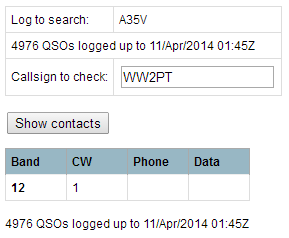
A35V Tonga on 12m CW, so weak I can barely hear him above the background noise. Send my call, I hear WW2... come back. Send it again, I hear...PT. Send my 5NN and log it. Within seconds, I'm in ClubLog. DXCC #185!


 I love this hobby!


Wednesday, March 26, 2014

Redefining The Radio (or, Nine Months With The Flex 1500)

Cooler than penguin poop.
I've not written much about the Flex 1500 since I brought it home about nine months ago, just a few mentions here and there. It doesn't get nearly as much use as my K3 but I reckon I've had enough cockpit time to become familiar with all the controls and tweak the software that an update might be in order.

Why the Flex 1500?
I first became interested in the 1500 shortly after it was announced by Flex Radio Systems. I was QRT at that time but I still kept my ear to the ground with respect to new equipment, especially QRP rigs, and this one really grabbed my attention. Around the same time Elecraft announced their KX3. I'm encouraged to see these two companies catering to the "little pistol" QRP op even as they shake up the "big gun" high-end/high-performance transceiver market with their K3 and Flex 5000/6500/6700 models. Especially fascinating is the different approach each of them take with respect to SDR design: the Flex 1500 is a black box device that sites between a antenna and a PC; the KX3 is a self-contained SDR radio that can be used independent of a computer (or an AC outlet, for that matter). Two completely different design philosophies.

Of course I wanted both radios; fiscal restraints, however, forced me to choose one or the other. I opted for the Flex partly because I really wanted to explore their universe a little bit after years of being fully in the Elecraft camp, and partly because of price -- the 1500 costs $699, the KX3 starts at $899, and the extra few hundred bucks really wasn't in my budget at the time. So the 1500 it was.

I envisioned this radio fitting into my current station primarily as a low-power digital-mode radio, and also as a second receiver. Now that I've become more interested in getting involved in QRP activities I can see it getting more use as a CW rig as soon as I work out a way of switching my key and paddles easily between the Flex and the K3.

First Light
My first impressions were mixed -- the initial PowerSDR setup was fairly straightforward but I had some issues getting it configured with the Virtual Audio Cable (VAC) and Virtual Serial Port (VSP) software and was finding some latency issues in CW mode  -- a very short but noticeable delay between key-down and hearing the sidetone that really is disconcerting while trying to send code at anything above Novice speed. It took some experimenting with the audio and DSP buffer settings before everything worked, if not perfectly then well enough. Nothing especially problematic, just a case of needing time to get acquainted with the intricacies of the different applications needed to get the rig working in a usable fashion.  

I eventually got everything working perfectly with both VAC and VSP. This allows a single USB cable between the 1500 and the Dell laptop to be used for the PowerSDR software (which is, for the most part, all of the radio after the RF stage), Ham Radio Deluxe (for additional rig control and logging), and DM780 or JT65-HF (for digital modes). No audio cables required!

The buffer and latency settings took a bit more work. Flex's Knowledge Center and the Flex-Radio email reflector are both great sources of information for dealing with these issues and any others. In particular, I found this post by VE3WMB to be especially helpful as a starting point for getting the 1500 dialed in. I also got some key advice on VAC setup from the Flex Radio SDR community on Google+. While there is still some latency when operating CW, it is useable in that mode, although I am limited to slower sending speeds than I'm comfortable with. The only way I can get around it is to reduce the CW buffer, which in turn limits the minimum bandwidth settings. Since others have reported success in eliminating this CW latency I'm still hoping to find the magic settings someday. 

Operating the Flex 1500
I noted above that the 1500 was purchased mainly for digital modes, and it's worked out extremely well for that purpose. I've been able to dabble with JT65 for the first time and have made some DX contacts running 1.5 watts. PSK operation is quite good, too. Channeling the audio I/O as data via USB seems to deliver a cleaner signal to and from DM780 than I'm getting from the desktop PC/soundcard setup I use with the K3. This is just the impression I get, I have not done any tests to support this hunch. At the very least, the possibility of RFI getting in through audio cables should be a non-issue now.

First, the positive:
  • The cornerstone feature of this rig is it's spectrum display. It makes it easy to spot weak signals that are barely audible -- the kind you would tune right past if you were turning a VFO dial on a conventional rig. See a line on the waterfall, click on it and you're tuned! More on this below.
     
  • I expected a great receiver from the reviews and receiver tests I'd read before purchasing it but it still took me by surprise. On CW the 1500 is simply amazing. The bandwidth filtering and it's ability to dig out weak signals is a match for the K3 in all but the most extreme cases, at least to my ears. It sounds great on SSB, too, though I haven't done much listening in that mode.
     
  • MultiRX is super-useful in a pileup situation, when I want to listen to my RX frequency (the DX station) in my left ear and monitor my TX frequency (the pileup) in my right. Unfortunately it's not possible to use different bandwidth settings for each channel. 
On the downside:
  • I find the Noise Blanker (NB) to be a bit disappointing. Perhaps I've been spoiled by the K3's NB, by far the best I've ever experienced. If it's just a simple matter of not having the the parameters set correctly, then I'd say that's one of the problems -- it shouldn't take that much tweaking and effort to work properly. I've spent a lot of time adjusting the 1500's NB settings and I'm unable to find the sweet spot where the background electrical noise that often plagues my QTH is eliminated without causing distortion to the desired signal. No such issues with the K3, where I can just increase the NB level until it distorts, then back it up a little.
     
  • The DSP Noise Reduction (NR) is OK, but again not nearly as effective or easily adjustable as the K3's NR. I rarely use it.
     
  • Portability is another issue. "QRP" is often synonymous with "portability," and this rig simply ain't. If field operation is high on your priority list, either look elsewhere or prepare to lug around a bunch of batteries to power both the 1500 and a laptop.

User Interface
Despite it's (relatively few) shortcomings, I love the Flex 1500. Still, the K3 is my go-to rig and the Flex has been getting only occasional use. Why? It's not merely because of the additional output power of the K3 -- that may be part of it, but I'm fairly certain I'd do the same if the Flex were a 100W rig driving an amp. And not because of any performance issue, either -- as I noted above, the Flex is pretty much equal to the K3, and possibly better in terms of audio quality (my K3 is one of the early ones and has none of the revisions that address some audio distortion issues).

More than anything, it's just that I still prefer a conventional button-and-knob rig to a point-and-click rig. When I want to turn the volume down, it's unintuitive for me to fumble with the mouse and drag a slider on a computer monitor. When I want to change bands, it seems so much more natural to push a physical button than click on a virtual one. Is this just a generational thing? Would a younger user, someone who has been exposed to computers from the cradle, be more comfortable with PowerSDR and find a conventional radio to be a quaint relic of the past? I don't know.

Whether I'm "old school" or just stubborn, the K3 suits my operating style. This often includes tuning slowly across the band listening for weak signals with my eyes closed, something that is not easily done with PowerSDR. I ride the RF Gain control, too, and again find it cumbersome to work a slider control with the mouse to do that. I suppose the awkwardness of PowerSDR can be lessened with time as I use it more, but I don't think the point-and-click interface will ever match the tactile feedback I get from an honest-to-God front panel. 

But then there's the panafall display! That is what for me sets this radio apart from anything I've ever experienced before. PSK users know all about waterfall displays which show signals in the audio passband; panadapter spectrum displays have been a mainstay on rigs from Icom since the IC-780 and R-9000 in the 1990s and now feature prominently on rigs from nearly every manufacturer. The panafall display is a combination of the two, showing real-time band activity in both the frequency/amplitude and frequency/time domains.
PowerSDR's Panafall Display
A CW or digital signal too weak to really stand out on the panadapter display will often still leave a faint line on the waterfall. These are the signals that one risks tuning past on a conventional rig. But on the Flex... see a line, point and click, bang. It almost feels like cheating.

Here's an example of a station (HC5AI) I found while doing some A/B tests between the 1500 and the K3. It was so weak that it didn't register at all on the panadapter display (top) but was clearly visible on the waterfall (bottom):


Odds are that I wouldn't have found this signal if I were just tuning the band on my K3 or if I were using just the panadapter display on the 1500. (This was one of those extreme cases in which the K3 beat the 1500 in terms of copying a signal so far down in the background noise that it was barely audible. Not a huge difference in readability, but noticeable.)

So why not use just the waterfall? Why have a panadapter display at all? Maybe the panadapter is just gravy, but I find it to be very useful when there are a lot of signals on the band, especially during a contest or while hunting DX. Observing a pileup of big signals spread out over a 2-3 kHz range just disappear when a weaker signal starts transmitting on a lower frequency -- the telltale sign of a DX operation -- is something that just doesn't come across as well on the waterfall. On the other hand, the waterfall is my tool of choice when monitoring a quiet band, especially the higher bands which open and close intermittently at night. That's when I will just leave the waterfall on and wait for the broken lines to appear.

This panafall method of finding and tuning weak signals is a paradigm shift for me, another one of those things that I could never have imagined when I was a kid listening to hams on a DX-160 receiver with a simple bandspread dial. Back then, a simple digital frequency readout seemed miraculous to me! I'm happy to say it's not unique to Flex radios these days, either. The Elecraft P3 panadapter option for the K3 includes this feature; NaP3, an SDR software program based on the open-source PowerSDR code, brings many of PowerSDR's user interface to the KX3 and, with devices like the LP-Pan, other rigs with suitable IF outputs; most if not all other SDR radios support software with similar functionality; the Kenwood TS-990S has it on its built-in display, and I expect Yaesu and Icom will follow soon enough. Maybe someday a panafall display will be as ubiquitous as digital readouts and computer interfaces are on radios today.
Elecraft P3
NaP3
Kenwood TS-990S
Just for the hell of it I recently hooked the K3's IF output up to the Flex 1500 and tuned the 1500 to the K3's IF 8 MHz frequency. The results were not great -- the signal level of the IF signal was pretty low so only the strongest signals on the band were showing up in the PowerSDR panafall; tuning the K3 up in frequency moved the waterfall in the opposite direction (i.e., higher frequencies are to the left of the center marker, lower to the right), something that makes perfect sense if you think about it but still less than intuitive when operating; and of course the point-and-click facility was missing. In all, and interesting exercise but a rather useless way to add a spectrum display to the K3.

My Wish List
Two things would make me even happier than I already am with this radio: A Macintosh version of PowerSDR, and an internal ATU option.

The $900 Question
Anyway, these are my random thoughts about the Flex 1500. If I had to do it all over again, would I have gone for the KX3 instead of the Flex 1500? I've been asking myself that question a lot lately and the answer is a definite and resounding "maybe." The appeal of having a stand-alone, fully functional QRP rig that I can use outside the shack wasn't a huge factor for me last June. Today I really wish I had one. I have no complaints with the Flex when it's used as I originally intended -- as a digital-mode rig -- and actually use it more than the K3 these days for PSK. At the same time I wish I had a KX3-type rig that I could use both in the field and in the living room.

That said, I have no regrets. I chose the 1500 knowing what it was and how it worked, and it honestly has met all my expectations. So I don't know if I'd go the other way and get the KX3 instead of the 1500. Hopefully I will own both someday because they each fulfill a particular need for me.


Resources and Links
Monitoring Times review by NT0Z - Part 1 and Part 2 (PDF format)
DL4YHF's Overview of Spectrum Displays
W9XC: Flex 1500 CW Latency Issues

Thursday, January 16, 2014

K3 Noise Blanker Magic


So many things to love about the K3, but chief among them is the noise blanker. I have an almost constant S7 to S9 noise level (from the power transformer that is about 30 feet away from my antenna, I suspect) and the K3 takes it pretty much in stride.

This example was recorded earlier this morning (UTC; last night local time) listening to IS0HFE in Sardinia calling CQ on 40m. I worked him a few minutes later before I lost him to QSB. I honestly don't know that I'd have even heard him on most other radios I've used in the past -- certainly not the JST-245 which despite being my second favorite rig ever had a noise blanker that was practically useless.

In hindsight I wish I'd done a side-by-side comparison with the Flex 1500. I've had no luck finding a NB setting with the Flex that removes this level of noise without completely distorting the signal. I'll chalk it up to operator incompetence until I know for sure, but I'm pretty sure I've tried every imaginable setting in PowerSDR and it hasn't come close to the K3 yet.

The more pressing question is, how do I get rid of this noise? There are times it goes away all on its own (when it's raining a lot, it seems... unless that's just a coincidence). It was quiet a few weeks ago until (of course) NAQP CW weekend, and I had to deal with this for the entire contest. I've been meaning to head outside with a portable receiver and a loop antenna to see if I can't get a fix on the noise and confirm that it's the transformer but I've had other pressing matters of late. And if it is the transformer, how do I approach the utility company in order to get results?

But for now, I just push the NB button and the noise drops to a level at which I can at least hear some of the weaker signals, though the noise level remains S5-S6 at the best of times.

Monday, December 16, 2013

2013 ARRL 10M Contest

My first all-CW effort in a contest that was mixed mode. Also the first test in which I used N1MM Logger to generate the CW. This worked swimmingly. No more pushing buttons on the K3 to send my call and exchange from CW memories!

Bad noise the whole weekend -- not just the usual electrical noise (though that was bad enough) but the neighbor's dog would not shut up. And the train... folks, never buy a house across the street from the railroad tracks. Union Pacific is at the top of my shit list this weekend.

QRV a bit under 12 hours total operating time with lots of short breaks. Since the Tarheel only tunes up to 21 MHz, I had to keep the amp off and use the K3's ATU to match the antenna. Consequently, I could only hear and work the loudest signals on the band.

In the end, 22 states (not incl. KL7 and KH6), 9 CanProvs, and 29 DXCC. No new all-time countries for me, but every one of the 29 is new on 10m, a band for which I have exactly three QSOs in the log in 26+ years. Got 8 of the 24 state I need for the CW portion of Triple Play (five already confirmed on LOTW!).

Thursday, December 5, 2013

T32RC Eastern Kiribati


I was checking the 40m CW band around 1230 UTC this morning before work looking for V63XG in Micronesia -- I just barely heard them above the noise yesterday morning, not strong enough for me to feel confident about dropping my call. I doubt I would have heard them come back to me. No sign of them today, however. The hunt goes on.

What I did find, however, was a pileup on 7011. Tuned down 1  to 7010, and there was the T32RC DXpedition on Kiritimati Island (the erstwhile "Christmas Island"), part of the Line Islands in the Republic of Kiribati (better known to WW2 buffs as the Gilbert Islands where the Battle of Tarawa was fought, about 2,000 miles due west along the Equator) and the DXCC entity amateurs know as Eastern Kiribati.

Still half-awake and not yet fully caffeinated, I flipped on the amp and found a clear spot in the pile. Dropped my call once and got him. I think. Lots of electrical QRN this morning. I went about my morning business and came back into the shack about 15 minutes later, when I decided an insurance QSO might not be a bad idea. I generally avoid doing this but I'm not sure I'll have another chance before they go QRT on 10-Dec. Got him on the first call again (how is this even possible, with a screwdriver antenna on 40m? But I digress...). With two QSO's in the log I started to shut down and head to work... but first, I thought, I should check ClubLog just for the hell of it. And there, no more than 30 minutes of my first QSO, T32RC had uploaded their log and I was in it. This is an unbelievably awesome operation.

Did I mention this is another all Elecraft DXpedition? :-)

Saturday, August 3, 2013

K3 Receiver Sensitivity Loss With KPA500

Ever since adding the KPA500 to my station, the bands have been dead. Perfect timing as always, or so I thought at first. After a week and all propagation indices suggesting the ionosphere had not in fact packed up and left, it slowly began to dawn on me that perhaps there was something wrong in the signal chain.

I went as far as bypassing my Delta 4 antenna switch and connecting the antenna feedline directly to the amp -- a drop in signal strength being one of the signs that the gas cartridge might have gone bad --  but no change. I did not, however, bypass the amp and connect the antenna directly to the K3.

Finally, I saw a thread entitled K3 Receive Attenuation with KPA500 in Operate while perusing the Elecraft email reflector and it all clicked. Brian W3BW wrote:
I am running a newly assembled "K-Line" --- K3/100, KPA500 and KAT500.  The K3 is pretty "loaded" with KRX3, KAT3, KXV3A, etc.
I just noticed that received signals are down 4 S-units when the KPA500 is in Operate.  In Standby, signals pop right up. 
Reading past reflector emails on the topic, I found one thread that suggested this may have to do with the state of the KPA500 PTT.  I found that pulling the PTT RCA plug out ended the problem. 
This 4 S-unit drop was exactly what I was experiencing. A response from Don W3FPR confirmed it to be the PTT cable used in parallel with the KPAK3AUX control cable:
I have heard this before, and as I recall it has to do with the DB15 cable and the PTT cable when used together. 
Are you using the PTT cable in addition to the cable from the K3 ACC cable?  If so, pin 10 of the cable should not be included.  See the note on page 8 of the KAT500 manual. 
Normally you would not have to use the PTT cable with the K3.
The KPA500 manual does not mention this, at least not clearly, in the Cabling instructions:

  1. Connect your station ground to the GND thumbscrew {10}. A good station ground is important for safety and to minimize local radio frequency interference (RFI).
  2. Attach the RF INPUT {11} to the output of your driving transceiver or transmitter using a 50 ohm coaxial cable with a PL-259 male connector on the KPA500 end. The driving transmitter must supply up to 40 watts for full output from the KPA500.
  3. Attach the RF OUTPUT {1} to a suitable load with an SWR of less than 1.5:1. A dummy load is strongly recommended for initial testing.
  4. Connect the PA KEY {6} to the driving transmitter Key Output. A suitable cable is supplied with your KPA500. The transmitter must ground this circuit during transmit while sinking up to 1 mA from the PA KEY line. If the transmitter Key Output is not a contact closure or equivalent, it must be at a level between +4 and +16 VDC during receive. (Compatible with all known transmitters. No key line buffer required.)
  5. Optional: An auxiliary (AUX) connector is provided that permits more closely integrating the operation of the KPA500 with many transceivers, including the Elecraft K3. A suitable cable for use with the K3 is available from Elecraft. See AUX Connector Interface on pg 18.
  6. Optional: RS232 (PC) {9} connects the KPA500 to your personal computer with a standard 9-pin serial cable. Required for updating the KPA500 firmware.
  7. Optional: RS232 (XVCR) {8} connects the KPA500 to a Kenwood transceiver using a standard 9-pin serial cable. This connector cannot be used to update KPA500 firmware (see pg 14).
  8. Optional: ALC OUT {7} provides level information to control the driving transmitter RF level. The output is negative-going from 0 VDC to -12VDC. 
I read the above as, "You need to connect the PTT cable, and the AUX cable if you want additional control of the amp with the K3." And what receiver sensitivity might have to do with the PTT key line is beyond my understanding. But at least I had a clue.

Removing the PTT cable seems to have done the trick for me. Now both signals and background noise are back to normal levels.


Sunday, July 28, 2013

2013 RSGB IOTA Contest

I didn't really give this any serious effort, did not even get on the air until after 0200, so I'm not even going to send in a log. But it gave me a chance to give the KPA500 a good shakedown and she performed as well as I could have expected. The screwdriver antenna is still the limiting factor for me -- no amplifier is going to help me work DX that I can't hear. And it was slim pickings for a while. But when 20m opened up to the Pacific after 0330, I cracked a small pile and worked South Cook Is. (E51GC) on the first call.

In all, I only made 20 contacts (16 DXCC, 10 WAZ), picked up a new one (E51), worked Corsica (TK) and Ireland (EI) for the first time since moving to Texas, and the usual assortment of VK, ZL, KH6, and South America/Caribbean stations.

Saturday, July 27, 2013

KPA500 Passes Smoke Test


The KPA500 arrived Thursday. I started assembling it after work and got as far as sorting the parts and mounting the tilt bail and feet, power supply module, and left side panel. Finished the job on Friday night... er, Saturday morning, around 2am. Hit the sack after testing into the dummy load. Looks like full 500w takes about 35w drive from the K3 on 20m.

Wednesday, July 17, 2013

KPA500 on the way


There goes the grocery money for the next two months. But it had to be done.

Sunday, July 14, 2013

2013 IARU HF World Championsip

Phone operation only, low power (100w), three bands (40m/20m/15m).

Band conditions were not great, but my local noise level was downright oppressive, as high as S9+20dB on 40m. Bad transformer out on the pole? I dunno. Thankfully the K3 has the best NB system of any radio I've ever used, so I was able to knock it down to a mere (!) S7 or so and manage to hear stations near the noise level (thank you Elecraft!), otherwise it was going to be a short test for me.

N1MM Logger once again makes me wonder how people operated contests before contest logging programs.

DXCC: 26 Countries. Only new one, I think, was the "new" PJ4 Bonaire (PJ4NX on 20 and 40).

WAS: 32 States (per QRZ). Got some needed state/band combinations, I'm sure.

QRV: Approx. 16 hrs, for 176 QSOs -- not exactly big gun performance. Sometimes I felt like I was working QRP. Into a dummy load. With bad coax...
  • 1230-1430 - 20m
  • 1430-1830 - 15m
  • 1830-2115 - Break
  • 2115-0130 - 20m
  • 0130-0300 - 40m
  • 0300-0600 - 20m
  • 0600-0700 - Break
  • 0700-0745 - 40m
Final Claimed Score: 30,876


Tuesday, March 9, 2010

NCJ: What's the Best Contest Rig?

The March/April 2010 National Contest Journal arrived yesterday, torn and tattered as always (thanks again, US Postal Service!), and with it the results of K3MD's informal poll of top contesters asking, "What's the best contest rig?" It's by no means a scientific survey, nor all-inclusive, but many of the Big Guns you'd expect participated.

No surprise to see the K3 and IC-7800 at the head of the pack. What does surprise me, though, is the absence of even a single mention of the Flex 5000 -- can't figure this out. Contesters, of all operators, rely so heavily on computers and software, and the Flex is clearly ready for prime-time. It's fairly equal to the K3 and 7800 in terms of receiver performance. It just seems like a natural fit. Is it simply because it lacks a tuning dial? Is full PC control too new a trick for these old dogs to learn? Would love to hear theories as to why none of these top contesters have jumped on the SDR bandwagon.

Also surprised to see the Orion get only passing mention (and not in a good way, either). Wasn't that the last "greatest-thing-since-sliced-bread" transceiver just a few years ago?

All that said, I'm happy to see the K3 get the attention it deserves from the radiosport community. Contesters at this level are fickle creatures; you can't pin the fanboy label on them. Price is rarely an issue, considering the equipment on the inside of the shack typically costs a fraction of what is spent on antenna systems. They're not swayed by fancy front panels or clever marketing. If the radio works better than what they last used, they keep it; if something else better comes along later, they'll switch again. It will be interesting to see in ten years or so whether the K3 has the longevity among contesters that, say, the FT-1000D has enjoyed. My prediction: Yes (but then, I'm just an Elecraft fanboy and, worse still, a poseur-wannabee contester). Only time will tell; the zeitgeist changes direction in a hurry, and the DSP and SDR technology is advancing rapidly, so something new could come along next week to knock the K3 off its pedestal.

Friday, February 19, 2010

K3 Derangement Syndrome

Seems W9OY is causing some heads to broil on the Elecraft list, thanks to Julian G4ILO stirring the pot. ;-)

I don't know W9OY but I read his blog often because I'm fascinated with the whole SDR aspect of the hobby. He's as much a fanboy for the Flex 5000 as many are for the K3 (including me, I suppose). I have no problem with that, we all like to talk up the equipment we own. W9OY certainly knows his stuff, and even though he may toss out a jab at the K3 every now and then I just take it with a grain of salt -- no burning desire to break out the dueling pistols, it's just a hobby.

Often, though, I've heard hams on the air trashing the K3 as though anyone who owns one isn't just wrong, but stoopid as well. I call it K3 Derangement Syndrome: any mention of the K3 causes them to prattle on about how inferior it is to their radio. They'll harp about the K3's "poor ergonomics," as if pressing a button twice to move from 40m to 20m is somehow more of an inconvenience than having to boot Windoze every time you want to use your radio. They'll talk about the size of the radio, as if the compact box isn't one of the K3's attractions for many owners. They'll nitpick over specs, as if they really make a difference while working the DX. Mostly, it becomes evident after listening for a while that most of these K3DS sufferers have never actually used a K3, but merely heard all these horrible things from someone else. I guess the P3 will give them more ammo because it's smaller than Power-SDR running on a 60" plasma display -- your sophomoric "mine's bigger" kind of argument. Whatever.

Life is too short. We all have reasons for choosing the radios we choose. My big reason for not buying a Flex product is that it relies on Windoze; if it supported OS X, I might have one on my desk right now. But I have enough Windoze headaches in my daily life and don't really want them to be at the core of my radio hobby. As Bones might tell Kirk, "Damn it, Jim! I'm a ham, not a systems administrator!" Those who might actually enjoy dicking around with computers will almost certainly report different mileage. Good for them.

Another good question has already been raised by someone else: What happens in 20 years? I have a garage full of 10-year old computer peripherals that simply won't work with my current PCs and Macs. The Flex rigs, when you boil it all down, are computer peripherals. That it doesn't rely on USB drivers makes it more likely to be supported years down the road, but what happens if FireWire goes the way of 5.25" floppies? Or if future versions of Power-SDR no longer support anything older than the Flex 8000? To me, one of the things I love about ham radio is that people running vintage gear from the 50's and 60's are still able to do pretty much everything a guy with a K3 can do; with proper care and feeding, they can last a lifetime or more. On the other hand, computers and peripherals are throw-away items. Which category a PC-based SDR falls into, only time will tell.

That doesn't mean I won't someday own a Flex 5000 (or 6000 or 9000); maybe I will. Flex Radio Systems is every bit a great company as Elecraft, and their user base every bit as loyal. If I had the cash I'd probably own one now because I love the SDR concept. If someday it no longer works under Windoze 2036 or whatever cruel hoax Microsloth perpetrates on the masses in the future, oh well... out to the pile in the garage it'll go, to be replaced by the newest model. But I won't get rid of the K3 unless and until something else comes out that offers a significant improvement, and whatever may replace my K3 someday will sure as hell have knobs and buttons and be able to operate as a stand-alone instrument without a PC umbilical. These are my requirements; if yours are different, buy what you want.

And while others may take cheap shots at competing radios just to make themselves feel smart or superior to those who choose differently, I won't do that.

(I will, however, continue to take cheap shots at Microsloth Windoze. It just plain sucks.)

Saturday, February 13, 2010

Elecraft P3 Panadapter at Orlando Hamfest

Photo by Jack W3TMZ

Sunday, January 24, 2010

K3 Weirdness in AFSK-A Mode (SOLVED!)

During the BARTG test I had some weird moments after I QSY'd from 20m to 40m -- DM780 would key the K3's PTT (via HRD IP Server) but there would be no audio into the Line In port, and thus no RF output. Sometimes rebooting the K3 would work, other times quitting and re-launching DM780 did the trick. I'm not 100% certain of the cause but I'm leaning towards software rather than hardware.

Then I noticed low RF output at certain audio frequencies, and this only in AFSK-A reverse (USB) mode; no trouble in normal (LSB) AFSK-A mode, nor in DATA-A normal and reverse. The output power would be OK when the center frequency was set low on the waterfall (+/- 400 Hz, for example) but would drop off at higher Fc setings. And the cutoff point seemed to vary -- sometimes I could get full 100W RF out at around 1500 Hz Fc (I typically use 1530 Hz as Fc for RTTY), other times the output would drop above 900 Hz and be effectively zero at 1300 Hz and above. After some messing around with soundcard and line input levels I seemed to have gotten it somewhat sorted out, but as I did all that in the middle of a contest while in semi-panic mode I didn't take too many notes.

I did some basic tests today by transmitting RTTY diddles at 100W into the MFJ-267 dummy load/wattmeter while in AFSK-A REV mode; mic gain is adjusted for 3 flickering bars of ALC as per the advice of Elecraft. I got full 100W reading on the meter at 2200 Hz Fc, but it steadily decreased as I inched upwards -- at 2300 Hz Fc the output was down around 60W, and by 2400 Hz the wattmeter needle barely moved. But when I switched from REV (USB) to NOR (LSB) I get full output right up to the top edge of the waterfall (2900 Hz Fc) -- pretty much what I experienced yesterday during the RTTY test.

I then shut the whole system off for a while and repeated these tests an hour or so later to see if things changed from a "cold" state: starting out my output at 2200 Hz was down around 10 to 15W. The output then slowly rises as PA temperature (as measured by the K3's built-in PA TEMP meter) reaching full 100W at 43 deg C. But after cooling off (PA: 35 deg C, front panel: 32 deg C) power output remains at full 100W! This is driving me absolutely bat-shit crazy.

I'm not really concerned that I won't be able to transmit RTTY at high center frequencies as my operating style is to find and click on a signal in the waterfall, center it at 1530 Hz, then switch to a narrow filter setting; I'm more troubled by how the cutoff frequency changes, sometimes below 1530 Hz, and apparently is a function of temperature. It doesn't appear to be a PA problem -- the same power drops occur when bypassing the PA unit and running at 10W, and I'm getting full power in all other modes -- so I'm going to guess it's an issue with the DSP board and its handling of audio at the Line In port. More tests to follow, and when I have a better set of test results I'll contact the boys in Aptos.

Update 26-Jan-2010: I believe it has been solved -- the only things I didn't check until today were the filter parameters in the CONFIG menu. Sure enough, I had FL3 set to 2.4 kHz even though the filter is actually a 2.1 kHz filter. Unsure how or why this caused the problem, but since setting it to the correct setting I am now able to get full output power at the mark frequencies indicated by the K3's MARK-SH setting (2125, 1445, 1275 or 915 Hz). Not sure how the FL3 parameter got changed; perhaps inadvertently while running K3-EZ, or perhaps it was set improperly during my assembly and setup back in January '08. In any case, all's well that ends well. My apologies to Wayne, Eric, Lyle, Don, Greg, etc. for bothering them with what turned out to be user error. I will now sit in the corner wearing my "Dumb Ass" hat as penance.